Pickleball: understanding the game and its basic rules before your first game
Published 24 October 2026 Revised 24 October 2026 3 minutes to read
The editorial team at Le Tableau du Dimanche.
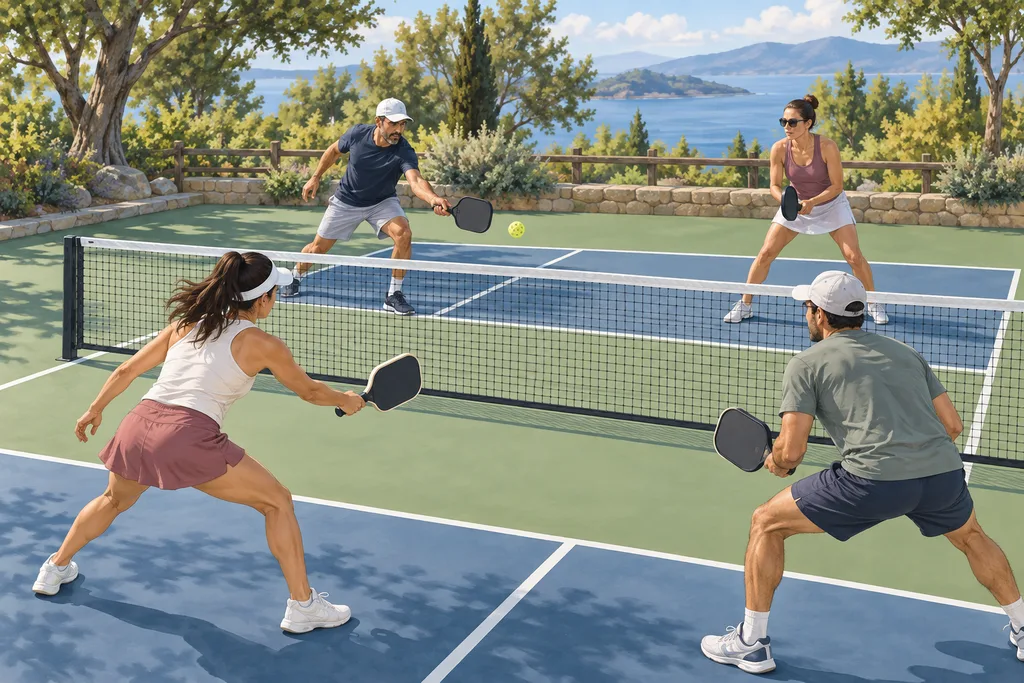
This entry, cataloged as “Pickleball: understanding the game and its basic rules before your first game,” gathers facts that were checked before being filed. You'll be able to explain how a point plays out, how scoring works, and the most common faults.
The words to define first
Here we open the glossary, filed by entry.
Double bounce rule
The double bounce rule requires the ball to bounce once on each side before volleys are allowed.
Here's an example of the term: the returner lets the serve bounce, then the server lets the return bounce before volleying.
For the full entry, see Double bounce rule.
Dedicated pickleball club
A dedicated pickleball club is a facility entirely devoted to this sport.
Here's an example of the term: in Nîmes, a club entirely devoted to pickleball was announced as the first in the South.
The full definition is in the entry Dedicated pickleball club.
How it works, in detail
As far as principles go, note this: in France, FFT pickleball competition takes the form of tournaments organized at four point-award levels: K25, K100, K250, and K500, plus the K1000 level for the big events. Keep this rule in front of you as you read.
Filed under principles: pickleball is most often played as doubles, though singles exists too.
The principle on file is this, the double bounce rule: after the serve, the ball has to bounce once on each side before volleys are allowed.
First landmark principle: only the serving team scores points; games are generally played to 11 points with a 2-point margin, and some tournaments may go to 15 or 21 points.
The step-by-step procedure
In procedural order, note this: every rally starts with an underhand serve, hit below the waist and diagonally. Check the source to confirm this step.
The decision factors up close
Hold your situation up against each of the criteria below.
- The double bounce rule cuts down the advantage of hard serves and makes for longer rallies.
- Pickleball is a racket sport that blends tennis, badminton, and table tennis, and it's played indoors or outdoors, as singles or doubles.
- Pickleball can be played as a family pastime or in competition, in mixed groups or across generations.
- The events offered at tournaments are singles, same-gender doubles, and mixed doubles, whatever the tournament tier.
- The basic equipment includes a paddle made of a rigid, non-compressible material and a plastic ball with 26 to 40 holes.
As a reality check, this specialty shop offers a glimpse with “Raquette Rally — Carbone T700”: one benchmark among others.
What can go wrong, in detail
We've spotted and filed the following pitfalls for you.
- The number after the letter K is the points awarded to winners in the 5.0 category, not the level required of players.
- The Elite 5.0 level isn't offered at K25 discovery tournaments.
Court and rules reference points
Dimensions and basic rules according to USA Pickleball.
| Item | Value |
|---|---|
| Court | 20 feet by 44 feet |
| Net height | 36 inches at the sides, 34 inches at the center |
| Non-volley zone | 7 feet deep on each side |
| Standard game | 11 points, with a 2-point margin |
| Ball | Plastic, 26 to 40 holes |
Reuse this table
Free to reuse, as long as you leave the link to the source.
<table><thead><tr><th>Item</th><th>Value</th></tr></thead><tbody><tr><td>Court</td><td>20 feet by 44 feet</td></tr><tr><td>Net height</td><td>36 inches at the sides, 34 inches at the center</td></tr><tr><td>Non-volley zone</td><td>7 feet deep on each side</td></tr><tr><td>Standard game</td><td>11 points, with a 2-point margin</td></tr><tr><td>Ball</td><td>Plastic, 26 to 40 holes</td></tr></tbody></table>
<p>Find the details on <a href="https://tableau-dimanche-d84.pages.dev/en/carnet/pickleball-comprendre-le-jeu-et-ses-regles-de/">Pickleball: understanding the game and its basic rules before your first game</a></p>
In the end: the essentials
Let's run back through your reading inventory: the words to define first, how it works in detail, the step-by-step procedure, and the decision factors up close. File this sheet with your documents and reread it at your leisure.
You may also like
- Pickleball: the rules for getting started — Rules, court, and equipment for your first game. The table of contents covers the following sections: the founding principles.
- What should you put in your bag for a first pickleball session? — You'll know what to bring or ask the club for so you can play from your first session. Sections filed on this page: when to put it to use.
- Beginner pickleball mistakes: non-volley zone, serve, and double bounce — You'll know how to avoid the faults that come up most often when you're starting out. In this piece, you'll read: the causes: the essentials.
- K25 to K1000 tournaments: read the category before you sign up — You'll learn to compare tournament categories and how many are held each year. The outline covers the following section: the concepts you need to know.
Our sources
- Tout comprendre à la compétition du pickleball — Tournament pyramid (K25 to K1000), 3.0/4.0/5.0 levels, and quarterly ranking updates. Document accessed 2026-10-15, before layout.
- Le pickleball — FFT landing page: rules, officiating, ranking, competitions, club map, and teaching resources. Document accessed 2026-10-15, before layout.
- What is Pickleball? — Basic rules, court dimensions, equipment, and the origins of the sport (American federation). Document accessed 2026-10-15, before layout.
The federal framework for pickleball in France has been evolving since the 2026 delegation: check licenses, fees, and regulations on the FFT website before you register.
How this article was verified
This article draws on 3 sources: reference organizations only.
The facts were checked against their sources on October 15, 2026.
The method we followed: Sources and verification.